
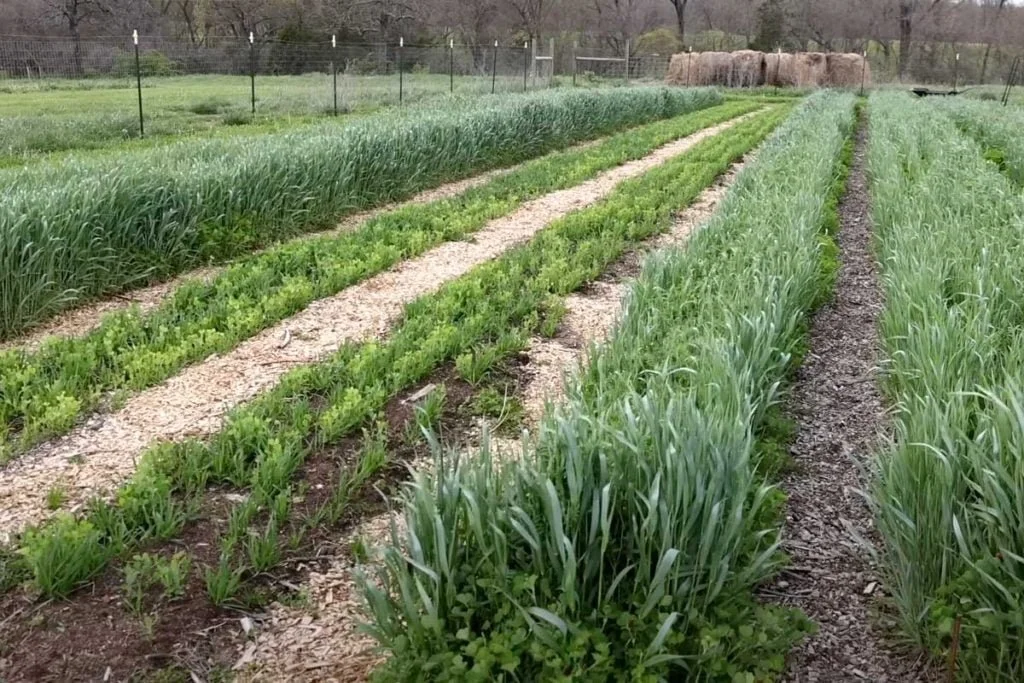
We’re located on 19 acres of land near the base of Bass Mountain (of the Cane Creek Mountain range) in southern Alamance County. Our market garden is designed to run on a human-scale with hand tools and minimal machine use. We’re organic except for the certification; we’d even say we’re beyond organic!
Overview
We follow time-tested organic practices that focus on creating healthy soil biology rather than just incorporating “organic” and non-synthetic commercially available products. The latter approach is one that many larger and corporate certified organic farms have adopted, which is modeled after conventional, industrial agriculture and its focus on chemical inputs. While it may be marginally better, it ignores soil biology at its peril.
We adhere to growing practices rooted in soil health. Instead, our approach centers on growing resilient crops from the soil up. Our philosophy is simple: when plants are grown in biologically active, mineral-rich soil, they are better equipped to resist pests and disease on their own. Every decision we make is aimed at feeding the soil first, knowing that healthy soil produces healthy, nutrient-dense plants. Here’s a breakdown of how we do this:
We’ve built permanent beds, which don’t get knocked down, compacted mechanically from heavy machinery, or moved around, which helps maintain soil structure long-term and concentrates soil biology in our beds.
Every season, we add organic matter into these beds with plant-based compost, grow diverse cover crop mixes and add minimal amounts of OMRI-approved organic amendments to jumpstart and build long-term soil fertility. Our pathways are mulched with wood chips, which decompose over time and are occasionally thrown into the beds to help add more organic matter and boost the mycorrhizal population to support plants growing in the beds.
Newly added organic matter and amendments are often incorporated with just the pass of a soil rake. Depending on the crop we plant, we sometimes use a BCS walk-behind tractor implement called a power harrow, which gently stirs the soil. Compare this to the typical tiller, which spins vertically with its tines that invert soil layers (and delicate microbes!) and create hardpan that makes it more difficult for plant roots and water to penetrate deeper. Our goal is to preserve the living structure of the soil with minimal disturbance of soil biology, which makes the soil itself healthy.
Our goal is to grow food at the highest possible nutritional level—food that contains the full spectrum of vitamins and minerals it should. Produce grown with this level of care naturally delivers exceptional flavor. Truly nutrient-dense food is increasingly rare, and its taste reflects that difference—something our customers notice and return for time and again. Working on a small scale allows us to prioritize quality, focusing on maximum nutrition from minimal acreage. Every harvest is carefully tended, thoughtfully handled, and packed with intention. We wouldn’t eat it ourselves if we didn’t put this much care into it!
Growing Practices
The market garden is about 2 acres of annual fruit and vegetable field crops, with approximately 150 beds at 100 feet long.
Four 14’ x 96’ fixed caterpillar tunnels in the field to provide more agile season extensions. Two more will be installed in 2026.
An additional 35’ x 96’ fixed high tunnel provides more season extension, especially for various long-term summer trellising crops.
Our 14’ x 36’ propagation house helps us to grow 95+% of our transplants on the farm throughout the year.
Layout & Infrastructure
We’re bringing back hedgerows! Yes, we plant a bed of native and flowering plants for pollinators and beneficial insects in-between each “section” of our market garden. These diverse plantings provide essential habitat and food sources for these insects, including predatory beetles, parasitic wasps and native bees that help regulate pest populations. We also plant groupings of grasses called “beetle banks"—raised strips planted with perennial grasses and flowers—that offer overwintering shelter for ground-dwelling predators. As perennial plantings, their permanence helps build up these insect populations whereas our annual food crops are being changed several times a year. All of this helps enhance biodiversity, improve pollination, reduce erosion, buffer wind, and create a more stable, self-regulating farm ecosystem that supports both crop productivity and long-term soil and environmental health. Plus they’re beautiful.